
• Navigation überspringen
  • Zur Navigation
  • Zum Seitenende
Organisationsmenü öffnen Organisationsmenü schließen
Friedrich-Alexander-Universität Lehrstuhl für Chemische Reaktionstechnik CRT
  • FAUZur zentralen FAU Website
  1. Friedrich-Alexander-Universität
  2. Technische Fakultät
  3. Department Chemie- und Bioingenieurwesen
Suche öffnen
  • en
  • de
  • UnivIS
  • Mein Campus
  • StudOn
  1. Friedrich-Alexander-Universität
  2. Technische Fakultät
  3. Department Chemie- und Bioingenieurwesen
Friedrich-Alexander-Universität Lehrstuhl für Chemische Reaktionstechnik CRT
Menu Menu schließen
  • Über Uns
  • Personen
  • Lehre
  • Forschung
  1. Startseite
  2. Forschung
  3. Arbeitsgruppen
  4. Komplexe Katalysatorsysteme und kontinuierliche Verfahren
  5. Hybrid Materials (HyMat) for Catalysis and Purification
  6. SCALMS catalysis

SCALMS catalysis

Bereichsnavigation: Forschung
  • Arbeitsgruppen
    • Heterogene Katalyse
    • Komplexe Katalysatorsysteme und kontinuierliche Verfahren
      • Homogene Katalyse
      • Ionische Flüssigkeiten & Molten Salts
      • Performance und Synthese von Ionischen Flüssigkeiten
      • Wasserstoff und Energie
      • Hybrid Materials (HyMat) for Catalysis and Purification
        • Catalytic Recycling of Plastic Waste
        • Reaction monitoring
        • Reactor design
        • SCALMS catalysis
        • SCILL catalysis
        • SILP gas purification
        • SLP catalysis
    • Poröse und hierarchische Materialien
    • Supported Ionic Liquid Phase (SILP) Katalyse
  • Publikationen
  • Technische Ausstattung
  • Verbundprojekte

SCALMS catalysis

Prof. Dr. Marco Haumann

Prof. Dr. Marco Haumann

  • E-Mail: marco.haumann@fau.de

Dr. Nicola Taccardi

Dr. Nicola Taccardi

  • Telefon: +49 9131 85-27429
  • E-Mail: nicola.taccardi@crt.cbi.uni-erlangen.de

Overview

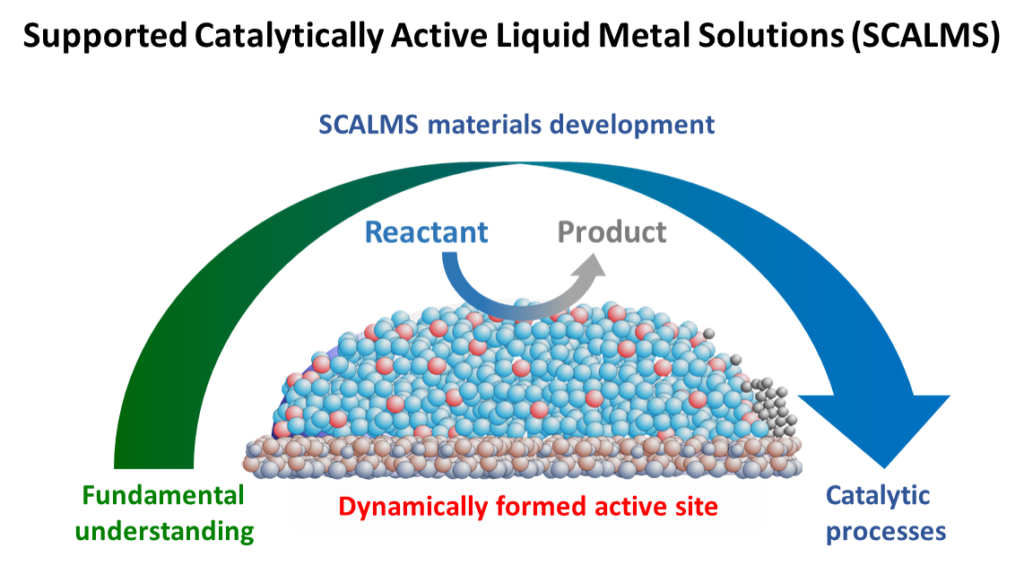
Dissolving small amounts of catalytically active metal in a matrix metal (like Ga or In) results in alloys that become liquid under elevated reaction conditions. These supported catalytically active liquid metal solutions (SCALMS) represent a new class of heterogeneous catalysts, since they enable single-atom catalysis at dynamic gas-alloy interfaces. The high dynamics at this interface and the electronic properties of the surrounding matrix metal induce completely new activity and selectivity patterns in single atom catalysis (SAC). Moreover, such systems can be more stable compared to traditional heterogeneous counterparts, since coking is less likely to occur on highly dynamic surfaces.

Selected publications

  • Raman N., Maisel S., Grabau M., Taccardi N., Debuschewitz J., Wolf M., Wittkämper H., Bauer T., Wu M., Haumann M., Papp C., Görling A., Spiecker E., Libuda J., Steinrück HP., Wasserscheid P.:
    Highly Effective Propane Dehydrogenation Using Ga-Rh Supported Catalytically Active Liquid Metal Solutions
    In: ACS Catalysis (2019), S. 9499-9507
    ISSN: 2155-5435
    DOI: 10.1021/acscatal.9b02459
  • Wolf M., Raman N., Taccardi N., Haumann M., Wasserscheid P.:
    Coke Formation during Propane Dehydrogenation over Ga−Rh Supported Catalytically Active Liquid Metal Solutions
    In: ChemCatChem (2020)
    ISSN: 1867-3880
    DOI: 10.1002/cctc.201901922
  • Oshin O., Nair SS., Taccardi N., Wolf M., Soegaard A., Haumann M., Wasserscheid P.:
    Stable and Selective Dehydrogenation of Methylcyclohexane using Supported Catalytically Active Liquid Metal Solutions – Ga52Pt/SiO2 SCALMS
    In: ChemCatChem (2020)
    ISSN: 1867-3899
    DOI: 10.1002/cctc.202000671
  • Wolf M., Raman N., Taccardi N., Horn R., Haumann M., Wasserscheid P.:
    Capturing spatially resolved kinetic data and coking of Ga-Pt Supported Catalytically Active Liquid Metal Solutions during propane dehydrogenation in situ
    In: Faraday Discussions (2020)
    ISSN: 1359-6640
    DOI: 10.1039/D0FD00010H

Project homepage

SCALMS ERC webpage


Friedrich-Alexander-Universität
Erlangen-Nürnberg

Egerlandstr. 3
91058 Erlangen
  • Impressum
  • Datenschutz
  • Barrierefreiheit
  • Facebook
  • RSS Feed
  • Twitter
  • Xing
Nach oben