
Overview
We are interested in following the progress of reactions by means of several analytical tools to derive relevant kinetic data. The usually continuous reactors are all connected to online analytical devices which either consist of micro-GC, process-GC or spectroscopic devices.
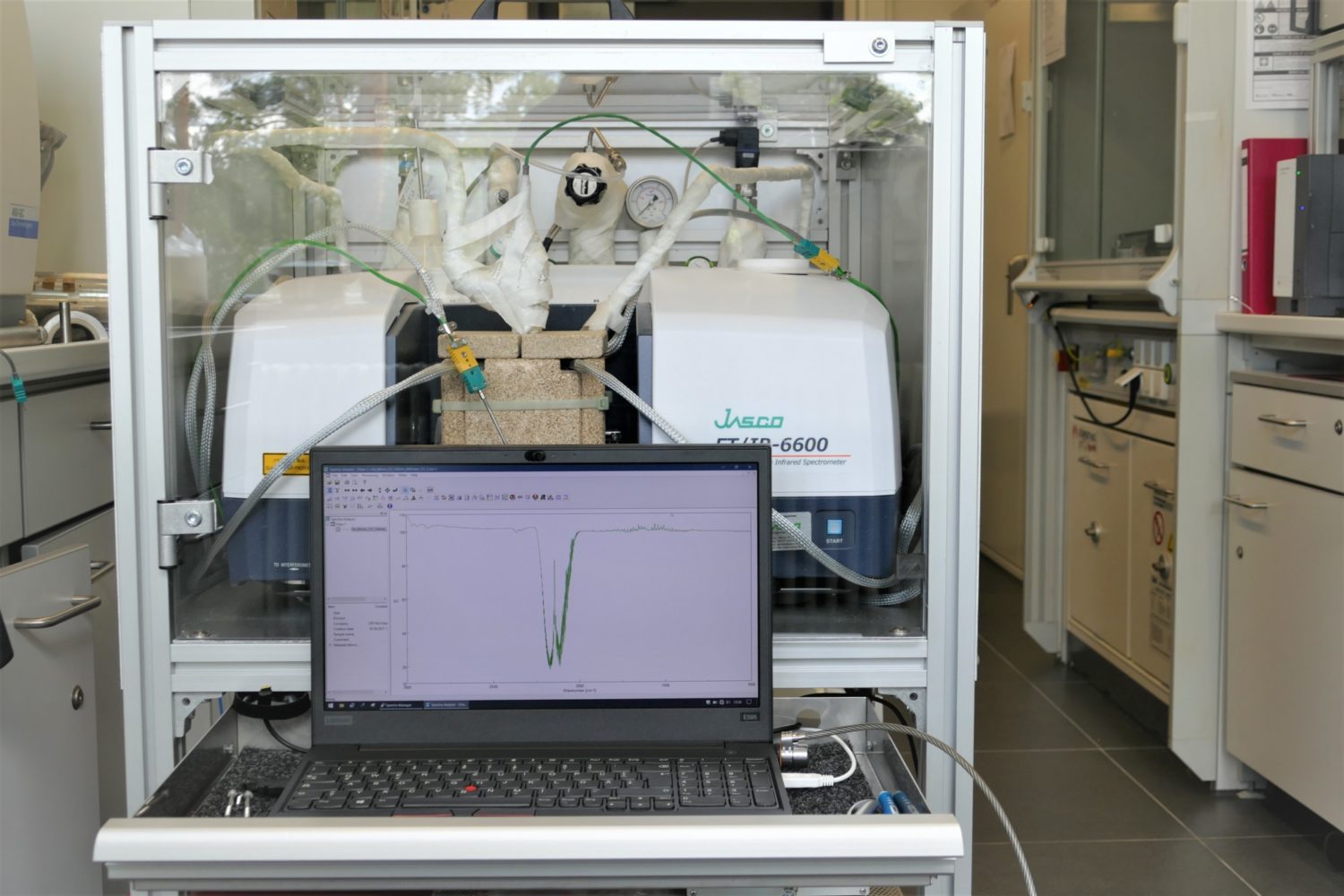
For the study of the active sites under relevant gas-phase operation conditions, we can make use of an in-house built FTIR cell. Small volumes of liquid-phase systems can be investigated by the use of photonic crystal fibers (PCF) as nano-reactors. The PCF approach enables reaction monitoring at extremely low sample volumes and with, compared to batch techniques, unprecedented temporal resolution. Larger volume of liquid-phase reaction mixtures have been investigated with the help of a high-pressure NIR flow-through cell. By chemometrical analysis the extraction of exact information out of the broad and overlapping NIR peaks and the data treatment of multivariate data sets is possible.
Determining the individual concentration profiles of substrate and products as well as temperature profiles along the fixed-bed axis is possible with the help of a compact profile reactor (CPR) designed by TUHH. We have demonstrated the feasibility for high temperature applications recently.
Selected publications
- , , , , , , , , , , :
Supported homogeneous catalyst makes its own liquid phase
In: Journal of Catalysis 321 (2015), S. 32-38
ISSN: 0021-9517
DOI: 10.1016/j.jcat.2014.10.019
- , , , , , :
Shining light on low-temperature methanol aqueous-phase reforming using homogeneous Ru-pincer complexes – operando Raman-GC studies
In: Reaction Chemistry & Engineering (2017)
ISSN: 2058-9883
DOI: 10.1039/C6RE00228E
URL: http://pubs.rsc.org/en/content/articlelanding/2017/re/c6re00228e#!divAbstract
- , , , , , , , , , , :
Dynamic equilibria in supported ionic liquid phase (SILP) catalysis: in situ IR spectroscopy identifies [Ru(CO)xCly]n species in water gas shift catalysis
In: Catalysis: Science and Technology 8 (2018), S. 344-357
ISSN: 2044-4753
DOI: 10.1039/C7CY02199B
- , , , , , , , , , , , :
Improving the performance of supported ionic liquid phase (SILP) catalysts for the ultra-low-temperature water-gas shift reaction using metal salt additives
In: Green Chemistry 21 (2019), S. 5008-5018
ISSN: 1463-9262
DOI: 10.1039/c9gc02153a
- , , , , , , , , , :
Cu carbonyls enhance the performance of Ru-based SILP water-gas shift catalysts: a combined in situ DRIFTS and DFT study
In: Catalysis: Science and Technology 10 (2020), S. 252-262
ISSN: 2044-4753
DOI: 10.1039/c9cy01852b
- , , , , , :
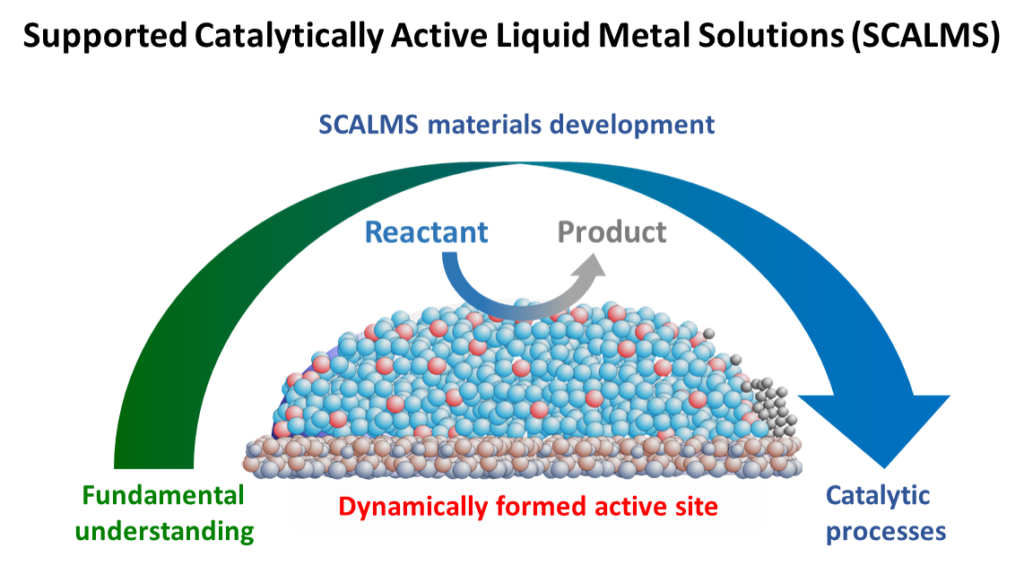
Capturing spatially resolved kinetic data and coking of Ga-Pt Supported Catalytically Active Liquid Metal Solutions during propane dehydrogenation in situ
In: Faraday Discussions (2020)
ISSN: 1359-6640
DOI: 10.1039/D0FD00010H
- , , , , , :
In-situ monitoring of homogeneously catalysed reactions using raman spectroscopy inside hollow-core photonic crystal fibres
CLEO: Science and Innovations, CLEO_SI 2020 (Washington, DC, 10. Mai 2020 - 15. Mai 2020)
In: Optics InfoBase Conference Papers 2020
DOI: 10.1364/CLEO_SI.2020.SM4M.8